Moldavite: a tektite
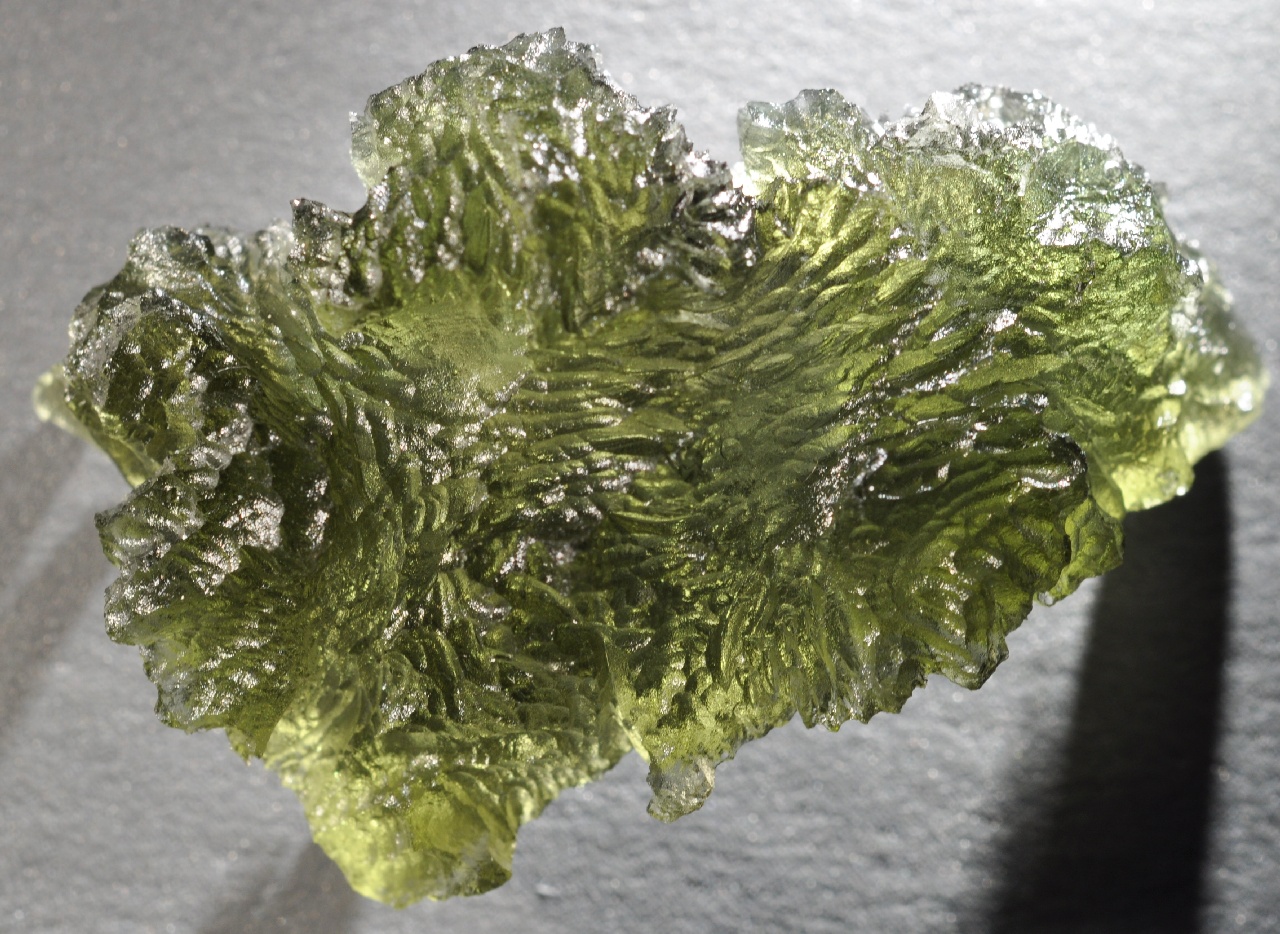
Tektites are the flying bits of earth that were ejected from a meteor impact site, which then land at a distant location.
These are the impact ejecta that do not make it out of the earth's gravitational field.
They are melted by the initial impact, and typically harden during their brief flight, and land some distance from the initial impact site that created them.
Moldavite is an olive-green or dull greenish vitreous substance formed by a meteorite impact.
It is one kind of tektite. It was named by A. Dufrnoy from Moldauthein in Bohemia, where it occurs.
It is sometimes cut and polished as an ornamental stone under the name of pseudo-chrysolite.
Its bottle glass color led to its being commonly called Boute-illenstein, and at one time it was regarded as an artificial product,
but this view is opposed to the fact that no remains of glassworks are found in the neighborhood of its occurrence,
moreover pieces of the substance are widely distributed in Tertiary and early Pleistocene deposits in Bohemia and Moravia.
For a long time, it was generally believed to be a variety of obsidian, but its difficult fusibility and its chemical composition
are rather against its volcanic origin. (borrowed from Wikipedia).
The initial impact that created the Moldavite deposits is believed to be the 15-16 million year old, 22km diameter, Ries Impact Crater, in Germany,
back to main page